The "Search Tax": Why Your Team Is Losing One Full Workday Every Week
Imagine hiring a new employee. Let’s call him Mark. You pay Mark a competitive market salary for a 40-hour work week, from Monday to Friday, but on Thursday afternoon, Mark stands up and says: "Well, that’s it for me. I’m heading home. Have a great weekend!" Even though it’s not even Friday.
You would never accept this. Yet, this is exactly what is happening in 90% of SMEs today.
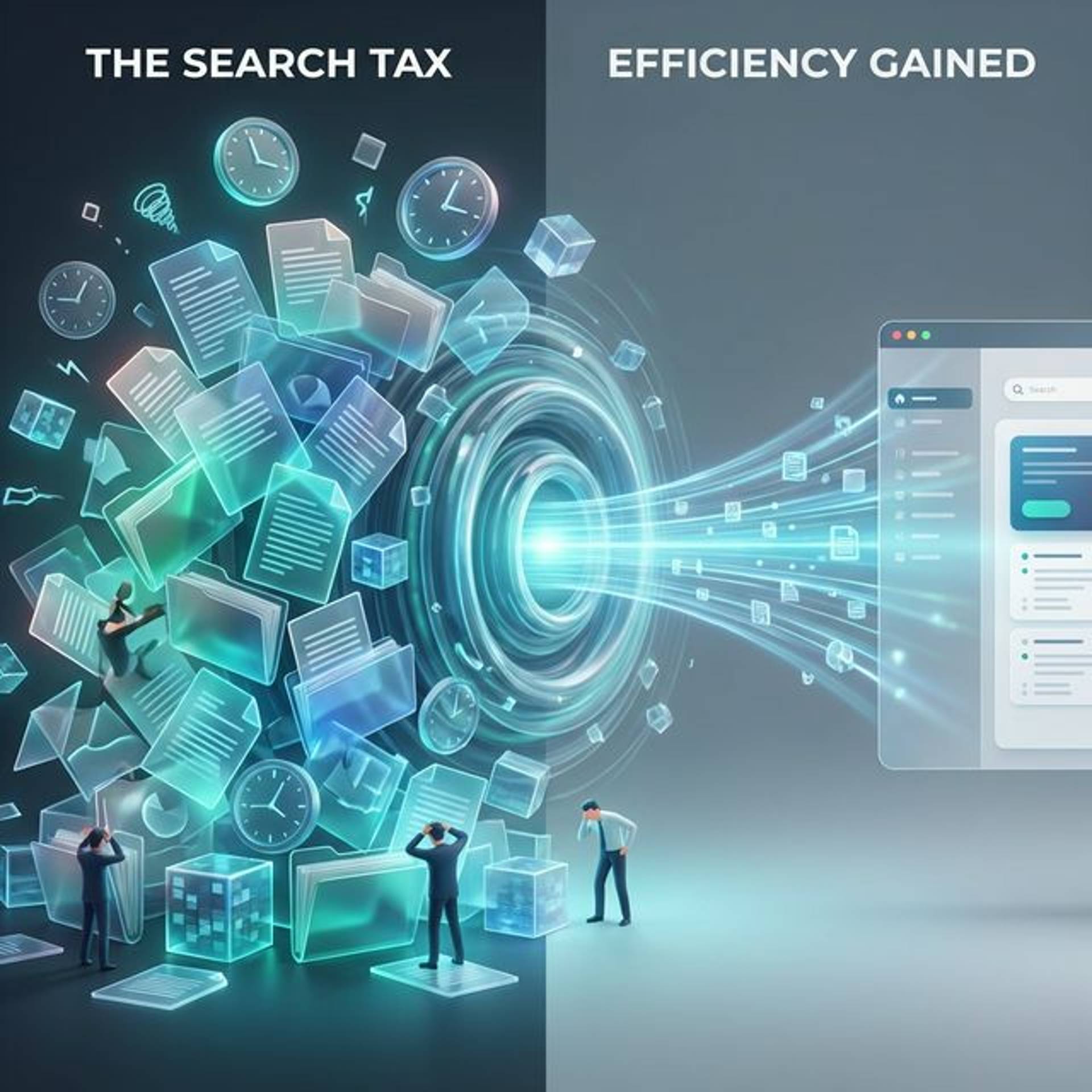
Your team loses an average of 20% of their time (one full workday!) searching for information, documents, and the correct file versions. This isn't laziness; it is a systemic failure. We call this the "Search Tax."
In this article, we dive into the shocking research from McKinsey and IDC, and explain why the "Downloads" folder is the biggest enemy of your profitability.
The Science of Lost Time
It sounds exaggerated: a 20% loss. But the data is relentless. The leading McKinsey Global Institute conducted extensive research into the productivity of knowledge workers. Their conclusion? Employees spend an average of 1.8 hours per day searching for and gathering information (Chui et al., 2012).
Do the math.
1.8 hours per day = 9 hours per week.
With a team of 10 people, you are paying 90 hours of salary per week for people who are producing nothing. They are simply searching.
The "Ghost Document" and the Re-work Crisis
The problem goes beyond just lost time. It leads to double work. Research by IDC shows that knowledge workers often give up in frustration when they cannot find a document. What do they do next? They recreate it.
According to a study by M-Files, 83% of employees have had to recreate a document that already existed, simply because they couldn't find the original on the company network (M-Files, 2013). This is capital destruction. You already paid for that proposal or contract once. Now, you are paying for it again.
Version Control: A Dangerous Game
Beyond time and money, there is the risk of error. When documents float around in inboxes ("Attachment: Proposal_V2_FINAL.pdf"), we create what computer scientists call Data Fragmentation.
The Horror Scenario: Your Account Manager sends Version 2 to the client. The client calls with a question. Your Support Agent opens the file, but sees only Version 1 (because Version 2 is locked in the Account Manager's personal inbox). The Support Agent gives advice based on outdated pricing or terms.
This doesn’t just cost money; it costs you your professional reputation. The client thinks: "These people don't talk to each other."
From Personal Possession to Institutional Memory
The root cause of this chaos is that we treat documents as personal property. They live on my desktop or in my sent items. As soon as that employee gets sick, goes on vacation, or resigns, that knowledge disappears from the organization.
Modern, scalable companies operate differently. They build an Institutional Memory. In a platform like Tixer Connect, information is decoupled from the individual:
- Centralization: Documents belong to a Client, not an Employee.
- Single Source of Truth: There is only one version of the file. Everyone looks at the same reality.
- Findability: No more digging through folder structures; you find files via the context of the client dossier.
Conclusion: Stop Paying the Tax
Ask yourself: Is your company a well-oiled machine, or a group of individuals each managing their own filing cabinet? The "Search Tax" is an invisible cost that eats away at your margins. Stop searching. Start finding. Centralize your documents and give your team that lost Friday back.
The Solution: Eliminate the Chaos with Tixer Connect
This is exactly why we built Tixer Connect. We didn’t just want another storage drive; we wanted to solve the context problem.
Instead of burying files in scattered emails or complex folder structures, Tixer Connect links every document directly to the Client Context.
- Centralized Portal: Your team and your client access the same environment.
- Version Control: Everyone is always looking at the latest version. No more "V2_Final" confusion.
- Instant Access: Documents are right there alongside the communication and planning.
Don't let your team waste another Friday on digital scavenging. Stop searching. Start working.
👉 Discover how Tixer Connect creates a Single Source of Truth for your business.